A large amount of clinically valuable information already exists within our healthcare systems, including medical images, pathology and radiology reports, laboratory results, treatment information, and longitudinal follow-up data. However, this data is usually distributed across different information systems, collected primarily for clinical care, and are not immediately suitable for multicentre research.
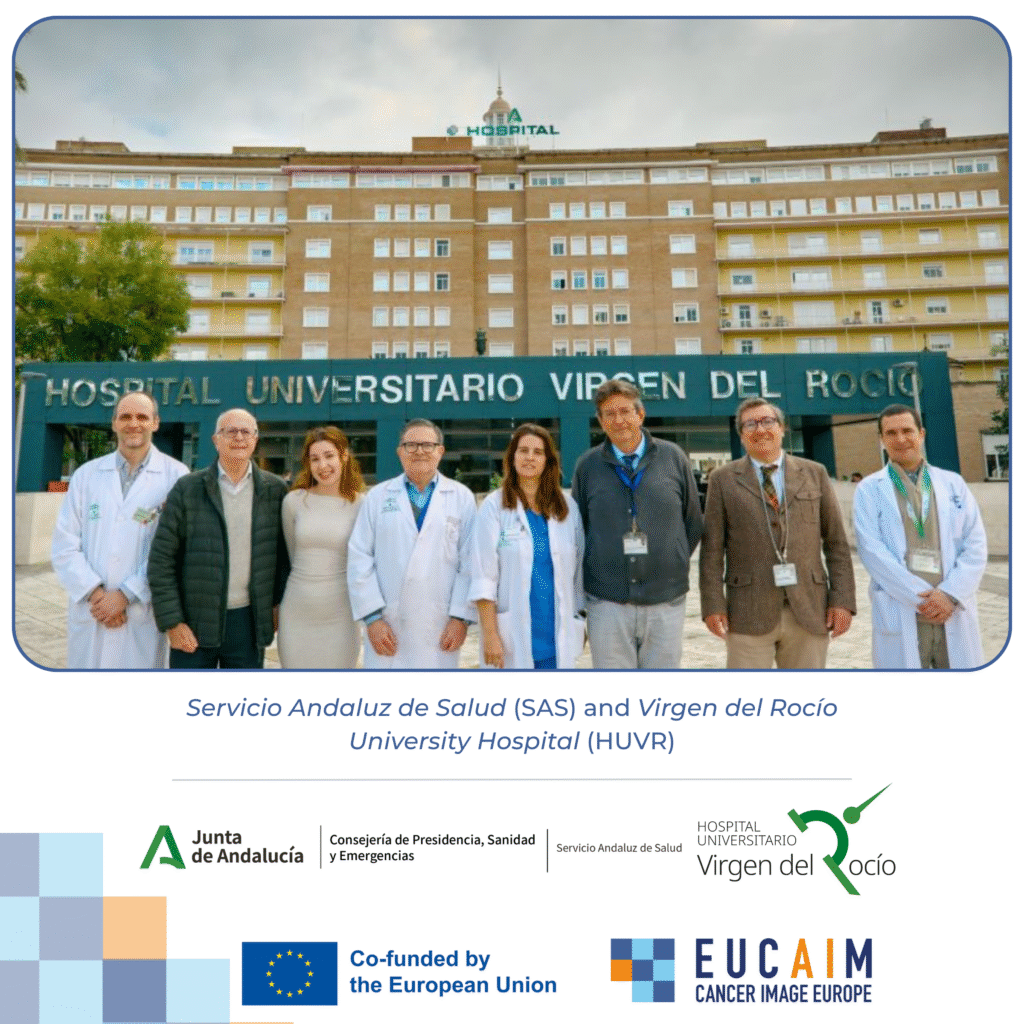
The Andalusian Health Service (Servicio Andaluz de Salud, SAS), through Virgen del Rocío University Hospital (HUVR) has joined EUCAIM as a data holder with the goal of unlocking the research value of real-world data by making it structured, interoperable, and reusable within a European framework.
With EUCAIM, the data becomes organised under a single hyperontology and complies with the federated model. This involves quality control of datasets, verification of DICOM integrity and metadata consistency, resolution of duplicates and inconsistencies, management of missing information, linking imaging and clinical data at the patient level, alignment of different clinical time points, and harmonisation and mapping of information to the EUCAIM Common Data Model.
For SAS-HUVR, “mapping real-world clinical information to a common data model has been one of the areas with the clearest learning curve,” and EUCAIM supports this process every step of the way. As a data holder, SAS-HUVR has also “benefited from technical support, dedicated meetings to resolve mapping questions, detailed documentation, and access to specific tools that have helped us progressively understand the federation requirements and refine our workflows.”
Moreover, being a data holder in EUCAIM has provided SAS-HUVR with more opportunities than initially expected, as the work carried out with the first datasets often paves the way for establishing reusable workflows and lessons learned that can facilitate the incorporation of subsequent datasets into EUCAIM.
For these data holders, participation in EUCAIM has an important institutional impact. It provides access to a European network of clinical, technological, and academic partners, advanced tools for data management and AI development, and opportunities to participate in multicentre studies while preserving control over their own data. At the same time, it strengthens internal capacity in areas such as data harmonisation, interoperability, federated infrastructures, and governance of the secondary use of health data.
Ultimately, the future vision for SAS-HUVR is to move from isolated data preparation efforts towards a more systematic and sustainable model for collaborative cancer research, in which high-quality real-world hospital data can support both new research questions and the development of clinically relevant AI tools. For the current use cases, this means contributing to more precise patient stratification and treatment planning and, where possible, helping to reduce unnecessary interventions, ineffective treatments, and avoidable treatment-related toxicity.
As of today, SAS, through HUVR, is contributing with four disease-specific multimodal oncology datasets derived from real-world clinical practice to EUCAIM through the EUCAIM HUVR Data Warehouse, a local federated node connected to the European infrastructure in compliance with Tier 3 of the EUCAIM Data Federation Framework.
Learn more about the EUCAIM Data Federation Framework Tiers
Explore the EUCAIM Catalogue